Mental Health for International Students 2027

Mental Health Support for Your 2027 Study Abroad Journey
Reviewed on 15 October 2026 for students planning a 2027 intake. This guide uses research and official service information available at the review date. Historical findings are labelled by country and study period; they are not predictions or measurements of student mental health in 2027. Recheck service availability with your university before travelling.
If you cannot keep yourself or someone else safe, call the emergency number where you are or go to the nearest emergency department. In the US or Canada, call 911; in the UK, call 999; in Australia, call 000. For crisis support, the US and Canada each have a 988 service. Country-specific contacts and official links appear below. Do not wait for an admissions advisor or a chatbot to respond.
What Has Changed for 2027 Planning?
- Use current support guidance: NIMH guidance reviewed in April 2026 explains self-care, warning signs and when to seek professional help. UKCISA's international student guidance includes support information and student experiences updated in 2026.
- Do not rely on old app lists: Woebot confirms that its app retired on 30 June 2025. It is no longer a current recommendation.
- Save the current Canadian crisis contact: Call or text 9-8-8 in Canada. This is separate from the US 988 service.
- Verify practical arrangements before departure: Ask about counselling waiting times, insurance exclusions, medication continuity, accessible support and whether a therapist can legally support you while you are abroad. Campus and country rules differ.
Mental health difficulties are not a personal failure. Social, financial, academic and health factors can interact. Support should be accessible and suited to your individual needs.
Introduction: Preparing for the Emotional Side of Studying Abroad
Studying abroad can bring new opportunities alongside financial pressure, loneliness and academic adjustment. A 2025 study in General Psychiatry analysed 44,560 international students in US higher education using annual Healthy Minds Study surveys from 2015 to 2024. Its findings support taking mental health seriously, but they are not a worldwide prevalence estimate or a forecast for your own experience.
The problem is not personal weakness, but a result of systemic, cultural, and psychological pressures. This guide empowers you to recognize, understand, and navigate these challenges with actionable strategies - so you thrive, not just survive.
Part 1: What the Research Actually Shows
The US study reported the following weighted estimates, comparing 2015/16 with 2023/24:
- Clinically significant anxiety symptoms: 20.46% to 36.47%
- Clinically significant depressive symptoms: 20.44% to 35.37%
- Reported suicidal ideation: 5.35% to 10.30%
- Reported counselling service use: 5.26% to 7.67%
- Study design: Repeated cross-sectional surveys, not a study following the same students throughout the period.
Interpretation matters: Screening results are not the same as a clinical diagnosis. The study is observational and cannot establish that studying abroad causes mental illness. Its US findings should not be applied automatically to Canada, the UK, Australia or other destinations.
Part 2: Why Getting Support Can Be Difficult
The study found that reported counselling use increased more slowly than symptom prevalence. These measures have different meanings and can overlap; subtracting them does not establish the number of people whose treatment needs are unmet.
For an individual student, practical barriers may include cost, waiting lists, unfamiliar booking systems, language preferences, stigma and uncertainty about confidentiality. Ask your university what is available, how to access urgent appointments and what alternatives exist while you wait.
Part 3: Understanding Your Primary Stressors
What causes this mental health crisis? International students face unique, compounding pressures:
- Academic Pressure: New educational systems, teaching methods and assessment expectations
- Financial Stress: Tuition, living costs, work restrictions and family expectations
- Social Isolation: Distance from familiar support networks and difficulty making friends
- Language Barriers: Communication fatigue and difficulty describing personal concerns
- Immigration Uncertainty: Questions about visa conditions and future plans
- Discrimination: Prejudice, exclusion and unfair treatment
- Cultural Adjustment: Homesickness and unfamiliar social expectations
These pressures can occur together. They are not mutually exclusive categories, and no percentage breakdown is assigned here.
Part 4: Challenges Unique to International Students
Academic Pressure in an Unfamiliar System
International students often come from highly competitive education systems. When they arrive at universities with different teaching methods, grading systems, and expectations, the transition creates cognitive overload.
The Challenge: You're not just learning new material - you're learning a new way of learning while functioning in a second language.
Language Barriers Beyond Communication
While many international students are proficient English speakers, language barriers create multifaceted mental health impacts:
- Academic Impact: Following lectures, taking notes, and expressing complex ideas in exams is exhausting
- Social Impact: Misunderstandings in conversations create anxiety about saying the "wrong thing"
- Psychological Impact: Communication difficulties can add to stress and make it harder to feel understood
- Access to Support: Ask whether a counsellor who speaks your preferred language or a qualified interpreter is available
Financial Stress - An Underestimated Crisis
Financial uncertainty can affect sleep, concentration and everyday wellbeing. Plan for the following:
- Tuition Costs: Use the current fee schedule for your course and intake, including any deposit deadlines
- Living Expenses: Budget for rent, food, transport, insurance and healthcare. Visa maintenance requirements are not a guarantee of actual living costs
- Work Conditions: Check the immigration authority's current rules for your visa. Do not assume a universal weekly work limit or rely on uncertain earnings to fund essential care
- Family Pressure: Many international students support families back home
- Currency Risk: Exchange rate fluctuations make budgeting uncertain
A practical step: Ask student support about hardship funding, budgeting advice and payment arrangements before a financial problem becomes an emergency.
Impostor Syndrome Phenomenon
Some students experience impostor feelings: a sense that they do not belong despite evidence of their abilities. These feelings are not a diagnosis and can affect domestic and international students alike.
Why International Students Are Vulnerable:
- Competitive admissions: You were selected from thousands; others got rejected
- Language concerns: Even with fluency, speaking with an accent creates self-doubt
- Cultural context shifts: Achievements that earned you admission don't translate the same way in the new culture
- High family expectations: Many carry the burden of family hopes and sacrifices
Social Isolation and Loss of Support Networks
Unlike domestic students who maintain childhood friendships and family proximity, international students experience a profound rupture:
- Time Zone Challenges: Video calls with family are often difficult to schedule
- Loss of Safety Net: The friends and family who "had your back" are physically absent
- Starting From Zero: Making meaningful friendships takes time; surface-level connections feel hollow
- Cultural Distance: Even close friendships may not understand your specific challenges
Discrimination and Racial Trauma
Many international students face discrimination for the first time or encounter it at intensified levels:
- Microaggressions: Comments about accents, appearance, or home country
- Exclusion: Being left out of social groups
- Visible difference: Standing out due to race, religion, dress, or accent
Research shows everyday discrimination is positively correlated with anxiety, depression, and social isolation.
Immigration Uncertainty
Policy changes create constant anxiety:
- Visa Concerns: Uncertainty about conditions, renewals and documentation. Verify rules with the relevant immigration authority or a qualified advisor rather than relying on social media claims
- Post-Study Work Rights: Uncertainty about employment prospects affects academic motivation
- Policy Whiplash: Students make decisions based on policies that suddenly change
Part 5: Culture Shock Is Not a Fixed Timetable
You may experience excitement, homesickness, frustration and growing confidence in different combinations. Some students adjust quickly; others need more time or additional support. These experiences do not follow a reliable sequence of weeks or months.
Do not dismiss persistent distress as a stage you must wait out. Depression and anxiety can occur at any point, including when academic work appears to be going well. Contact a qualified health professional if symptoms are severe, worsening or affecting daily life.
For practical adjustment advice, see UKCISA's guidance on facing culture shock.
Part 6: Recognizing Warning Signs
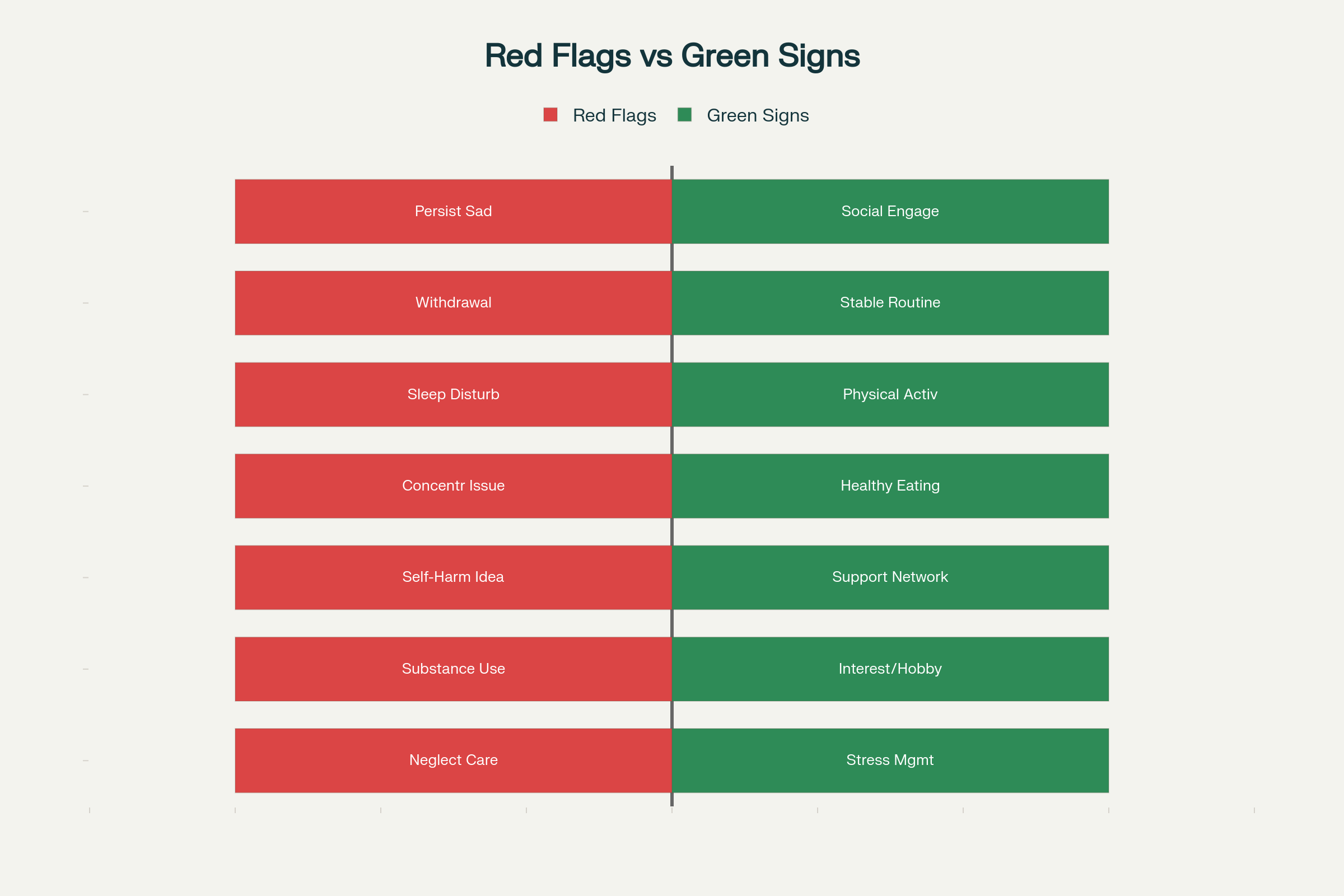
Red Flags - Seek Help Now
- Persistent sadness, hopelessness, or emptiness that doesn't improve
- Anxiety that interferes with daily functioning
- Panic attacks or overwhelming fear
- Significant withdrawal from friends and activities
- Dramatic changes in sleep or eating patterns
- Neglecting personal hygiene or appearance
- Inability to concentrate or focus
- Grades dropping significantly
- Increased alcohol or drug use
- Chronic fatigue that rest doesn't relieve
Seek support promptly: NIMH recommends professional help for severe or distressing symptoms lasting two weeks or more. This is not a waiting period: seek help sooner if symptoms are intense, worsening or affecting your ability to function. Thoughts of self-harm or suicide deserve immediate support. If you cannot stay safe, call local emergency services.
Green Signs - You're Thriving
These can be helpful signs of wellbeing, but they do not rule out a mental health condition. You can have good grades, friendships or an active routine and still need professional support.
- Regular social engagement with friends
- Stable sleep and eating routines
- Regular physical activity
- Strong support network
- Interest in activities and hobbies
- Effective stress management
- Good attendance and academic performance
Part 7: Everyday Strategies That Can Support Wellbeing
NIMH recommends routines, connection, movement and relaxation as aspects of self-care. Benefits vary between people. These strategies can support wellbeing and treatment, but they are not a substitute for assessment or care from a qualified professional.
Strategy 1: Build Social Support
A supportive relationship can make it easier to discuss concerns and ask for practical help. Start with an activity or group that feels manageable rather than trying to build a large network immediately.
How to Build Social Support:
- Join international student organizations and cultural associations
- Form study groups with classmates
- Visit professor office hours
- Join sports teams, fitness groups, or hobby-based clubs
- Volunteer for causes you care about
- Participate in religious or spiritual communities if applicable
Strategy 2: Stay Connected With Supportive People Back Home
- Schedule regular video calls at a consistent time
- Share your daily life through photos and videos
- Create shared experiences (watch movies together, play online games)
- Be honest about your struggles
Strategy 3: Respond to Self-Doubt With Self-Compassion
Treat yourself with the same kindness you'd extend to a good friend facing similar challenges.
Reframe Negative Self-Talk:
- Impostor Thought: "I don't belong here. Everyone else is smarter."
- Compassionate Response: "I'm experiencing self-doubt because I'm in a new environment with high expectations. This is normal. I was selected for this program because I'm capable."
Strategy 4: Find Manageable Ways to Move
Regular movement can support mood and physical health. Choose an activity suited to your abilities and preferences. Exercise is not a reason to stop medication or replace treatment recommended by your clinician.
- Start small: 20-30 minutes, 3-4 times per week
- Find what you enjoy: dancing, swimming, hiking, sports, or yoga
- Use university free gyms and fitness classes
Strategy 5: Try Relaxation If It Helps You
- Options: A walk, music, a guided relaxation session or a university wellbeing activity
- Start gently: Try a short session and notice whether it feels helpful
- Personal comfort: Stop an exercise if it increases discomfort or distress. Ask a professional for alternatives
Strategy 6: Establish Flexible Routines
When everything is unfamiliar, routines provide stability and predictability - which your nervous system desperately needs.
- Consistent wake/sleep times
- Dedicated study space and regular study sessions
- Wind-down evening routine (no screens 30 minutes before bed)
- Scheduled social activities and exercise time
Strategy 7: Nutrition and Sleep
- Sleep: 7-9 hours nightly, consistent sleep/wake times, cool dark bedroom
- Nutrition: Regular meals, protein and complex carbohydrates, stay hydrated, limit caffeine
Part 8: Culture-Specific Mental Health Challenges
The Cultural Stigma Factor
Attitudes to mental health vary within every community and family. Some students may encounter unhelpful beliefs such as:
- Mental illness = weakness or shame
- Seeking help = burden on family
- Psychological problems = lack of faith
How to Overcome Cultural Stigma:
- Reframe Your Understanding: Mental health challenges are medical conditions, not character flaws
- Connect with Others: Join cultural communities with progressive views on mental health
- Educate Your Family: Share mental health information; frame it as investment in your future
Language-Specific Challenges
For students not native to English, discussing mental health in the dominant language is particularly challenging.
Strategies:
- Find counselors who speak your language (if available)
- Learn mental health vocabulary in English
- Write down what you want to discuss before counseling appointments
- Ask counselors to explain things simply if you don't understand
Part 9: University Resources & How to Access Them
University Counseling Centers
What They Offer:
- Individual therapy/counseling sessions
- Group counseling for specific issues
- Crisis counseling
- Workshops on stress management, sleep, relationships
- Fees, session limits and referral arrangements vary. Confirm what your enrolment or insurance covers
How to Access: Find the counseling center (usually listed as "Student Health Services" or "Wellness Center"), book an appointment online or by phone.
What to ask: What is the waiting time? Is urgent support available? Can I choose a counsellor or request an interpreter? What happens if I need longer-term care? Who can access my records? Confidentiality generally has exceptions for serious safety risks or legal requirements; ask the service to explain its local policy.
Before you travel: If you already receive treatment, discuss the move with your clinician. Check medication import rules, prescription arrangements, insurance exclusions and follow-up care. Do not stop or change prescribed treatment without professional advice. If you may need a reduced study load or leave of absence, discuss the academic and visa arrangements with the appropriate university and immigration advisors.
International Student Offices
- Information about counseling services
- Cultural integration programs
- Peer mentoring
- Support for visa and immigration stress
- Connections to cultural communities
Peer Support and Student Organizations
- International Student Associations: Connect you with others from your country, organize cultural events
- Mental Health Support Groups: Anxiety support groups, depression support groups
- Faith-Based Communities: Many universities have chaplaincy services and counseling support
Online Support and Teletherapy in 2027
Online appointments may help with access, but availability, licensing and insurance cover depend on where you are physically located. Ask the provider whether sessions can continue legally after you move country.
- University options: Check which online counselling or wellbeing services your institution actually provides
- App availability: Woebot retired its app on 30 June 2025. Check current availability before relying on any named product
- Privacy and costs: Review data handling, subscriptions, age restrictions and whether a real qualified professional is involved
- Access while waiting: Ask a health professional about interim support rather than assuming an app is suitable for your symptoms
AI safety: General AI chatbots are not clinicians or crisis services. Do not use their replies to diagnose yourself, change medication or decide whether an emergency is serious. Avoid sharing sensitive medical or identifying information with a tool unless you understand its privacy policy.
Part 10: Neurodiversity and Study Abroad
Plan Support Around Your Individual Needs
Neurodivergence is not itself a mental illness. Students may need adjustments for learning, attention, communication or sensory needs, whether or not they also experience a mental health condition. Contact the university's accessibility service before arrival to discuss documentation and support.
Common Neurodivergent Conditions: ADHD, Autism Spectrum Disorder, Dyslexia, Dyspraxia
Challenges for Neurodivergent International Students
- Unfamiliar academic systems are harder for those with learning differences
- Sensory overload from new environments is more intense
- Executive function challenges (organization, time management) are magnified
- Different support options and documentation requirements across institutions and countries
What Accommodations to Request
- Additional exam time where approved following an individual assessment
- Separate testing room (reduces sensory distractions)
- Assistive technology (text-to-speech, speech-to-text)
- Flexible attendance policies
- Academic coaching (help with organization and planning)
Part 11: What Parents and Families Should Know
If you're reading this as a parent or family member of an international student, here's how you can support them:
Understand the Real Challenges
Your student isn't being dramatic or weak. The statistics show that international students face genuine, significant mental health challenges. Taking these seriously is the first step.
Stay Connected Without Hovering
- Schedule regular check-in calls (weekly is ideal)
- Listen more than you advise
- Ask about friendships and social life, not just grades
- Don't expect them to be constantly happy
Normalize Seeking Help
- Model healthy mental health practices yourself
- Don't treat mental health treatment as shameful
- Remind them that seeking counseling is strength
Provide Practical Support
- Help with financial planning to reduce money stress
- Send care packages with familiar food items
- Offer to help research mental health resources
Part 12: Creating Your Personal Wellness Plan
Rather than waiting for crisis, proactively create a personalized wellness plan:
Step 1: Assess Your Vulnerabilities
Ask yourself:
- What mental health challenges do I have history with?
- What triggers my anxiety or depression?
- What's my family's attitude toward mental health?
- Do I have any neurodivergence requiring accommodations?
Step 2: Build Your Support Team Before You Need It
Before Arrival:
- Research university counseling services
- Find support groups or communities you can join
- Identify cultural organizations
During First Month:
- Actually go meet your counselor (don't wait)
- Attend at least one international student event
- Join at least one club or group
- Make one friend in your program
Step 3: Create Your Emergency Plan
- Write down counseling center phone number
- Put crisis hotline numbers in your phone
- Identify 2-3 people you can call when struggling
- Know your university's after-hours crisis response
Part 13: If the First Attempt at Support Does Not Help
It is reasonable to ask for a different counsellor, an interpreter, a medical review or a referral if the first service is not a good fit. Explain what was difficult and what would make support more accessible. You do not have to navigate the options alone; a student support worker or a trusted person can help you make contact.
If a friend is struggling, listen without judgement and help them reach a qualified service. Do not promise secrecy if their immediate safety is at risk. In an emergency, contact local emergency services and share their location.
Part 14: Crisis Resources
Use the contacts for the country where you are physically located. Short numbers may not connect from another country or with every phone service. Check the official sites for current access options. If you cannot stay safe, call the local emergency number or go to an emergency department.
United States
- 988 Suicide & Crisis Lifeline: Call or text 988; online chat is available through the official site. Support is available 24/7
- Immediate danger: Call 911
Canada
- 9-8-8: Suicide Crisis Helpline: Call or text 988, 24/7
- Immediate danger: Call 911
United Kingdom
- Samaritans: Call 116 123, 24/7, as listed in NHS urgent mental health guidance
- Urgent support in England: Call 111 and select the mental health option. Elsewhere in the UK, check the local NHS urgent support route
- Immediate danger: Call 999 or go to A&E
Australia
- Lifeline: Call 13 11 14, 24/7. Text and online chat options are available through the official site
- Immediate danger: Call 000
Your 5-Step Action Plan
Ready to take action? Here's your practical roadmap for this week:
- Save your campus support contact and the local emergency and crisis numbers
- Check counselling access, waiting times and insurance coverage
- Choose one manageable routine and one supportive social connection
- Arrange continuity of any existing treatment with your clinician
- Contact a qualified service early if you are struggling, rather than waiting for a crisis
Conclusion: Thriving, Not Just Surviving
The US research discussed here highlights important support needs, but it does not predict any individual's experience. For a 2027 intake, the practical priority is to know where to get help, understand your healthcare arrangements and make room for wellbeing alongside academic preparation.
Understanding the challenges ahead means you can prepare. Knowing that others struggle means you're not alone. Having access to coping strategies means you don't have to suffer silently. Understanding your cultural context means you can navigate stigma. Knowing your university's resources means you have a safety net.
Studying abroad can be rewarding, and difficulties do not mean you have failed. Recovery and adjustment look different for everyone. Persistent symptoms should not be dismissed as temporary culture shock; appropriate professional support can help you decide what to do next.
But thriving - not just surviving - requires intentional effort:
- Build connections before you need them
- Establish routines that sustain you
- Practice self-compassion, not self-criticism
- Seek professional help without shame
- Remember that mental health challenges are medical, not moral
- Know that recovery is possible
Your mental health is not a luxury - it's a foundation. Everything else (academic success, career growth, meaningful relationships, cultural integration) becomes possible when you prioritize your psychological well-being.
You were admitted to your program because you're capable. You were accepted as an international student because you have something valuable to contribute. You're brave for pursuing this dream.
Now, be brave enough to take care of yourself while you're living it.
Recovery is possible. Seeking help is strength. You are not alone.
References and Current Support Resources
The research below describes historical US survey findings. The service pages provide current access information, not a guarantee of eligibility, availability or treatment outcomes. Links and guidance were checked on 15 October 2026.
- Zhai and colleagues: National trends of mental health and service utilisation among international students in the USA, 2015 - 2024. General Psychiatry, 2025. DOI: 10.1136/gpsych-2025-102124. Repeated cross-sectional Healthy Minds Study data from 44,560 international students; the numerical findings here are not global or 2027 estimates.
- National Institute of Mental Health: Caring for Your Mental Health. Reviewed April 2026; self-care and when to seek professional support.
- UKCISA: Mental health support in the UK. International student support guidance, with material updated in 2026.
- NHS: Where to get urgent help for mental health. Urgent help, emergency care and listening services.
- 988 Suicide & Crisis Lifeline. US crisis support.
- 9-8-8: Suicide Crisis Helpline. Canadian crisis support.
- Lifeline Australia: 13 11 14. Australian crisis support.
- Woebot Health FAQs. Confirms that the app retired on 30 June 2025.
Disclaimer
This article provides general educational information, not individual medical advice, diagnosis or treatment. Reviewed on 15 October 2026 for 2027 planning, it draws on the dated research and official guidance linked above. Service details can change. IvyEdgeSOP provides admissions guidance, not clinical assessment, therapy or crisis care. No clinician review of this article is claimed.
If you cannot stay safe: Contact local emergency services immediately, go to the nearest emergency department, or ask someone nearby to help you obtain urgent care. Crisis contacts depend on your physical location; the country-specific services above are not worldwide helplines.